At a glance
- Best months overall: late March to April and November, with mild days and few typhoons.
- Tokyo's wettest months are October (234.8 mm) and September (224.9 mm), not June.
- Cherry blossom opened in Tokyo on 19 March 2026, five days before the 24 March normal.
- Golden Week 2027 runs from Saturday 1 to Wednesday 5 May, with 29 April also a holiday.
- April (3.91 million) and October (3.90 million) were the busiest months for foreign visitors in 2025.
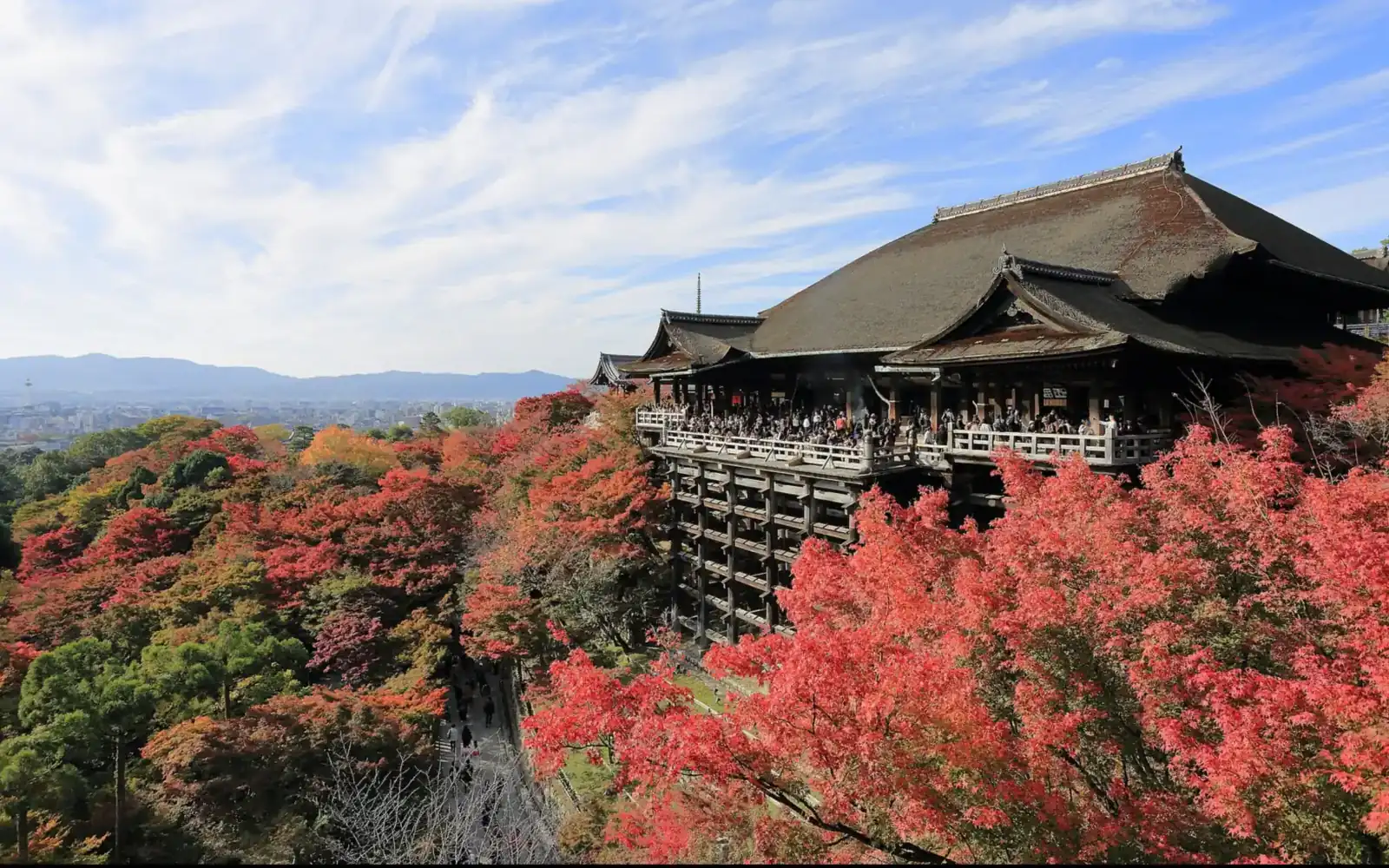
The best time to visit Japan is late March to April, or November. Both give mild days, the cherry blossom or the autumn leaves, and almost no typhoon risk. The catch is crowds: April and October were the two busiest months for foreign arrivals in 2025, and Japan’s own holiday weeks fill trains and hotels faster than any tourist season. Below, the Japan Meteorological Agency’s 30-year averages sit beside the official arrival figures and the 2027 holiday dates, all checked on 19 November 2026.
This page can link you to partner sites where you book; if you do, we may earn a commission at no extra cost to you.
When is the best time to visit Japan?
For a first trip built around Tokyo and Kyoto, aim for the last week of March to mid-April, or the whole of November. Pick spring if the blossom is the point of the trip and you can book early. Pick November if you want drier weather and more choice of rooms: Tokyo averages 96.3 mm of rain in November against 234.8 mm in October.
Two rules sharpen the choice. Keep away from the three domestic holiday peaks (Golden Week, mid-August and New Year), whatever the weather. And if your dates are fixed by school holidays, plan around the rainy season and typhoons rather than the blossom, because those affect every day of a summer trip. Once you have dates, compare hotels in Tokyo for those exact nights before you book flights, since rooms near the blossom peak go first.
Best month to visit Japan: weather and crowds month by month
Temperatures are the average daily high and rainfall the monthly average, from the agency’s 1991-2020 normals. Arrivals are foreign visitors to the whole country in 2025, from the Japan National Tourism Organization (JNTO).
| Month | Tokyo high | Tokyo rain | Kyoto high | Foreign arrivals 2025 | What to know |
|---|---|---|---|---|---|
| January | 9.8°C (50°F) | 59.7 mm | 9.1°C | 3.78 million | Dry and clear; Sapporo averages -0.4°C |
| February | 10.9°C (52°F) | 56.5 mm | 10.0°C | 3.26 million | Quietest month for arrivals |
| March | 14.2°C (58°F) | 116.0 mm | 14.1°C | 3.50 million | Blossom opens in Tokyo and Kyoto late in the month |
| April | 19.4°C (67°F) | 133.7 mm | 20.1°C | 3.91 million | Busiest month; Golden Week starts on the 29th |
| May | 23.6°C (74°F) | 139.7 mm | 25.1°C | 3.69 million | Golden Week to the 5th, then calmer |
| June | 26.1°C (79°F) | 167.8 mm | 28.1°C | 3.38 million | Rainy season from about 7 June in the Tokyo region |
| July | 29.9°C (86°F) | 156.2 mm | 32.0°C | 3.44 million | Rainy season ends about 19 July; humid heat after |
| August | 31.3°C (88°F) | 154.7 mm | 33.7°C | 3.43 million | Hottest month; Obon travel peak around 13-16 August |
| September | 27.5°C (82°F) | 224.9 mm | 29.2°C | 3.27 million | Peak typhoon month with August |
| October | 22.0°C (72°F) | 234.8 mm | 23.4°C | 3.90 million | Wettest month in Tokyo; second busiest for arrivals |
| November | 16.7°C (62°F) | 96.3 mm | 17.3°C | 3.52 million (estimate) | Autumn leaves in Tokyo late in the month |
| December | 12.0°C (54°F) | 57.9 mm | 11.6°C | 3.62 million (estimate) | Kyoto’s maples often still turning early on |
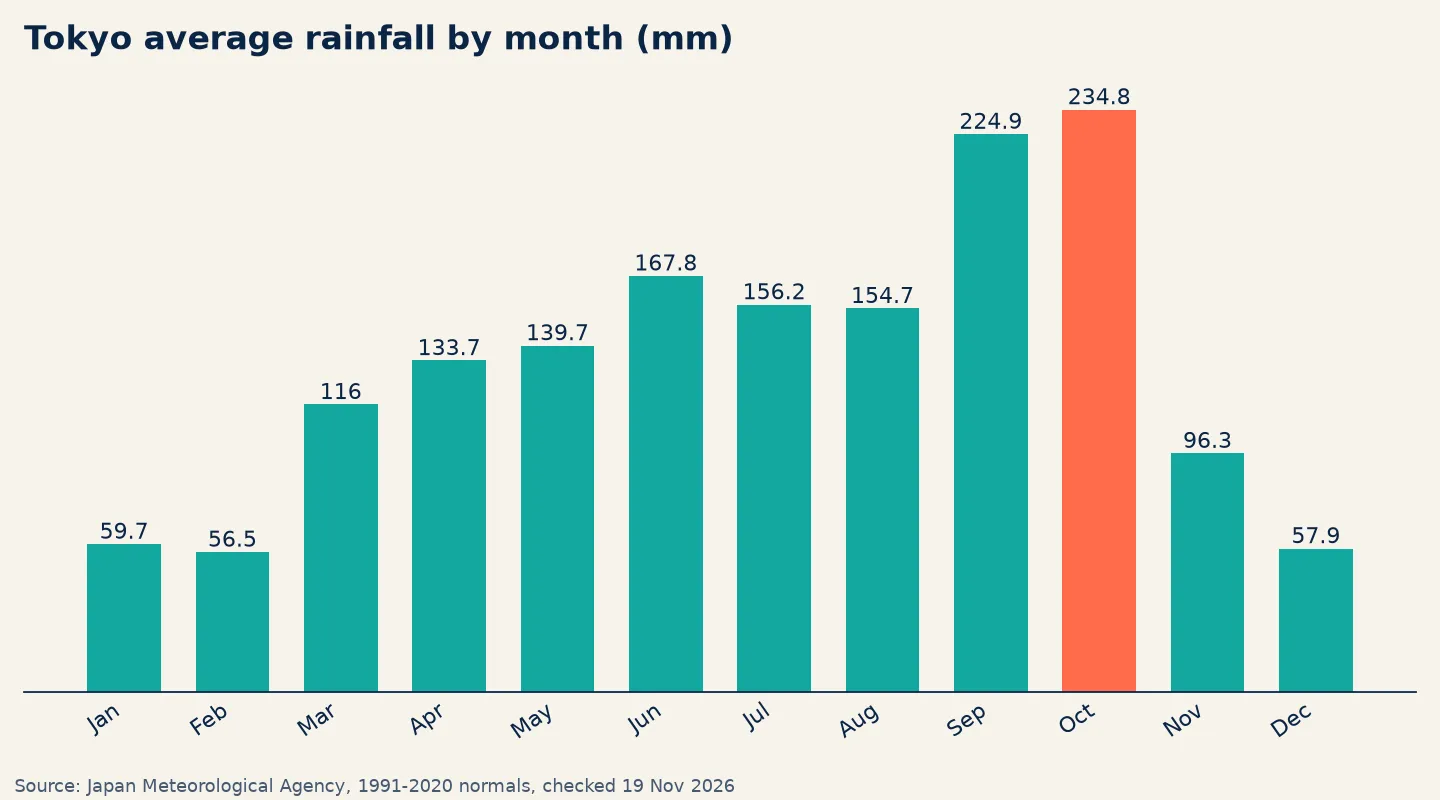
Read down the rain and arrivals columns and two patterns stand out. First, the rainy season is not the wettest stretch in Tokyo: autumn rain and typhoons make September and October wetter. Second, the gap between the busiest and quietest months for foreign arrivals is about 20%, from 3.26 million in February to 3.91 million in April. Japan never really empties of visitors; what changes prices and availability most is when Japanese residents travel.
Cherry blossom season in Japan: Tokyo, Kyoto and the north
The blossom reaches Tokyo and Kyoto in the second half of March and Hokkaido about a month later. The agency records a flowering date when five or six blossoms have opened on its sample tree, so full bloom follows some days after the date below.
| City | Flowering in 2026 | Normal date |
|---|---|---|
| Tokyo | 19 March | 24 March |
| Kyoto | 23 March | 26 March |
| Osaka | 26 March | 27 March |
| Sapporo | 18 April | 1 May |
In 2026 every one of those cities flowered early, Tokyo by five days and Sapporo by 13. That is the risk of booking a short trip for one week in late March: the date moves from year to year, and a week’s trip can miss the best of it. A trip of ten days or more that starts around 25 March and ends in Kyoto gives you two cities’ chances. If you can only book late, Sapporo’s later season is a fallback.
Japan rainy season and typhoons: the months to plan around
The rainy season (tsuyu) starts around 7 June and ends around 19 July in the Kanto-Koshin region that includes Tokyo, on the agency’s 1991-2020 normals. In the Kinki region around Kyoto and Osaka the normals are about 6 June to 19 July. Okinawa’s comes earlier, from around 10 May to 21 June. The agency describes each date as the middle of a changeover of about five days, so treat them as a guide.
Typhoons are the bigger planning risk because they can cancel flights and ferries. On the agency’s 1991-2020 normals, an average of 11.7 typhoons a year come within 300 km of a Japanese weather station. August and September have the most, 3.3 each, followed by July (2.1) and October (1.7). Landfalls average 3.0 a year, peaking in September. A late-summer trip still works, but leave a spare day before your flight home and pick a rate with free cancellation; our guide to free cancellation hotels covers what to check in the terms.
Cheapest time to visit Japan: the holiday weeks that push prices up
Room rates and fares rise most around Japan’s own holidays, not the foreign tourist seasons. JNTO describes the Bon holiday in mid-August as one of the busiest and most expensive times for travel in Japan, with plane, train and highway bus seats selling out in advance. It puts Obon on a par with New Year and Golden Week.
- Golden Week 2027: Showa Day on Thursday 29 April, then five days off in a row from Saturday 1 to Wednesday 5 May (Constitution Day, Greenery Day and Children’s Day fall on 3, 4 and 5 May). Friday 30 April is a normal working day.
- Obon: typically 13 to 16 August, says JNTO. It is not a public holiday, but it is when families travel home.
- New Year: 1 January is the only public holiday, but the days either side are a busy time to travel within Japan.
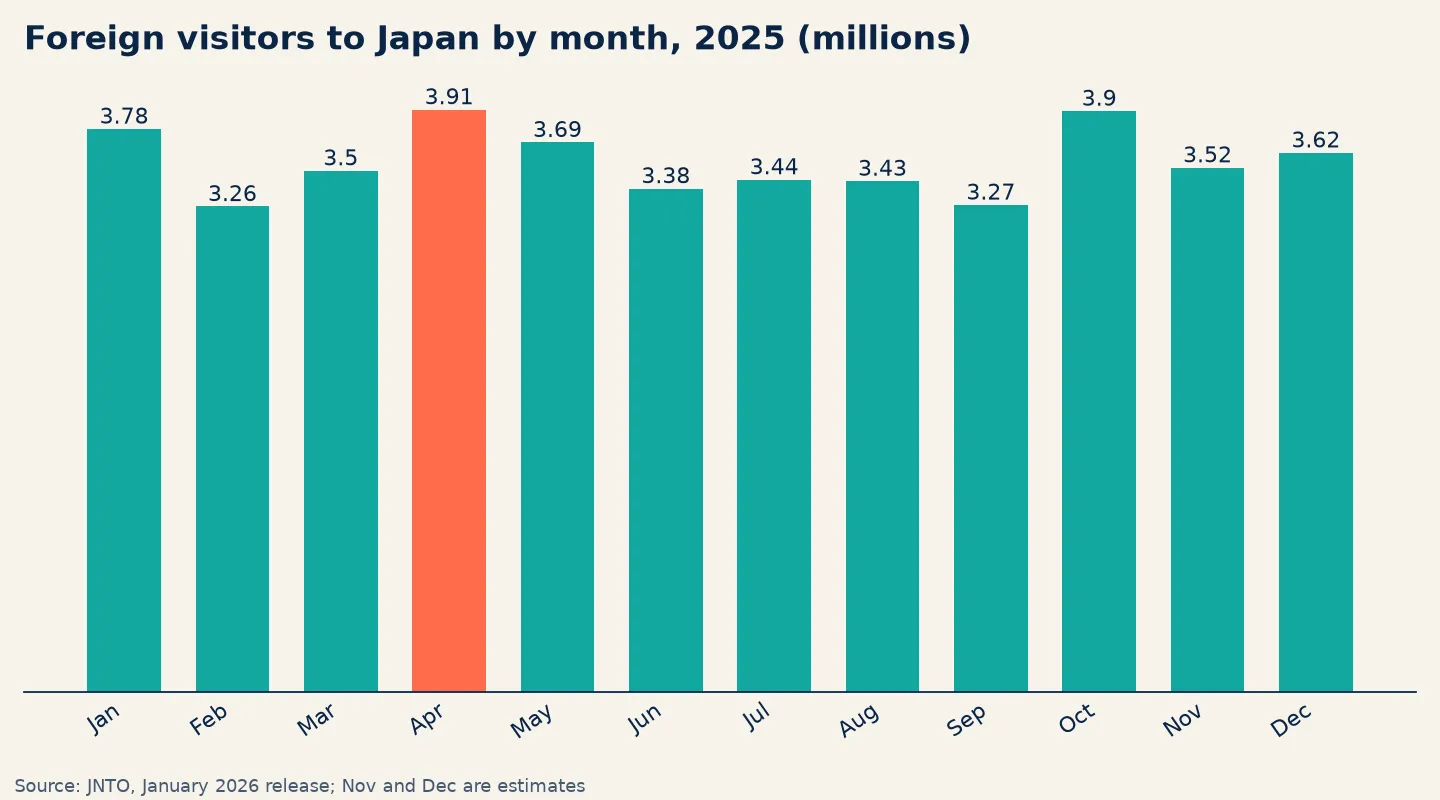
For the cheapest stay, the pattern points to February, or to the weeks between the end of the rainy season and Obon if you can handle the heat. February had the fewest foreign arrivals of 2025 and sits outside every domestic holiday. Our breakdown of whether Japan is expensive shows where the money goes once you are there, and when to book flights covers timing your fare. For hotels, compare a few date combinations, as our guide to finding cheap hotel deals explains, mixing weekday and weekend nights.
Best time to go to Japan for snow, beaches or autumn leaves
In January, Naha in Okinawa averages a high of 19.8°C while Sapporo stays below freezing, so for these three trips the region decides the month.
Autumn leaves
The maples turn from north to south and from the mountains down, which is why the season runs late in the cities. In 2025 the agency recorded Sapporo’s maples on 6 November, Tokyo’s on 23 November (five days earlier than normal) and Kyoto’s on 10 December (five days later than normal). For colour in Kyoto, the end of November into early December is the safer bet than October.
Snow in Hokkaido
Sapporo stays below freezing on average in January, with a mean daily high of -0.4°C, and averages 137 cm of snowfall in January, 116 cm in February and 113 cm in December. Those are the months for a snow trip.
Okinawa beaches
That January average makes Okinawa the one part of Japan that is mild in winter. Its rainy season comes earlier than the mainland’s, in May and June, and it sits in the path of late-summer typhoons. For a beach trip, July after the rains and before the peak typhoon months is the most reliable window, but book with free cancellation. If you want guaranteed heat in winter, our guide to the best time to visit Thailand is the comparison to make.
Frequently asked questions
Is October a good time to visit Japan?
October has comfortable temperatures, with an average high of 22.0°C in Tokyo, but it is Tokyo's wettest month on the Japan Meteorological Agency's normals and still sees an average of 1.7 typhoons approaching Japan. It was also the second busiest month for foreign visitors in 2025. November is drier and calmer.
When is the cheapest time to visit Japan?
February is the strongest candidate: it had the fewest foreign arrivals of any month in 2025 and falls outside Golden Week, Obon and New Year, the domestic peaks that push up rates. Prices still vary by city and day of the week, so compare several dates before you book.
How far ahead should I book for cherry blossom season?
As soon as your dates are fixed. The flowering date moves by days from year to year (Tokyo opened on 19 March 2026 against a normal of 24 March), so it pays to book rooms that cover the whole late-March window. A rate with free cancellation lets you adjust once the forecasts appear.
Is summer a bad time to visit Japan?
It is hot and humid: Tokyo averages 31.3°C in August and Kyoto 33.7°C. July and August also bring the start of typhoon season and the Obon travel peak. Summer suits Hokkaido, where Sapporo's August high averages 26.4°C, and Okinawa after its rainy season ends.
Sources
- Japan Meteorological Agency: Climate normals 1991-2020, Tokyo (checked 2026-11-19)
- Japan Meteorological Agency: Climate normals 1991-2020, Kyoto (checked 2026-11-19)
- Japan Meteorological Agency: Climate normals 1991-2020, Sapporo (checked 2026-11-19)
- Japan Meteorological Agency: Climate normals 1991-2020, Naha (checked 2026-11-19)
- Japan Meteorological Agency: Start and end of the 2026 rainy season, with normals (checked 2026-11-19)
- Japan Meteorological Agency: 2026 cherry blossom flowering dates (checked 2026-11-19)
- Japan Meteorological Agency: Maple autumn colour dates (checked 2026-11-19)
- Japan Meteorological Agency: Typhoon normals (checked 2026-11-19)
- Cabinet Office, Government of Japan: National holidays (checked 2026-11-19)
- JNTO: Visitor arrivals, December 2025 estimates and 2025 by month (checked 2026-11-19)
- JNTO Travel Japan: Japan in August (checked 2026-11-19)
- JNTO UK: Spend Summer Smart, Japan summer holidays on a budget (checked 2026-11-19)