
At a glance
- Best months overall: December to February, when Bangkok, Chiang Mai and Phuket are at their driest.
- Hottest month: April, with average highs of 34.9°C in Bangkok and 36.1°C in Chiang Mai.
- Wettest months: September in Bangkok (344 mm) and Phuket (387 mm), November on Ko Samui (490 mm).
- June to September beach trip: the Gulf islands such as Ko Samui get less than half Phuket's rain.
- Loy Krathong in 2026 falls on 24 November, the night of the full moon.
December to February is the best time to visit Thailand if your trip combines Bangkok, Chiang Mai and Phuket: all three are at their driest then, and the north has its coolest nights of the year. The exception is the Gulf of Thailand: Ko Samui does not dry out until February, and its wettest month is November. Thailand’s two beach coasts have opposite wet seasons, so the right month depends on which coast you mean. The figures below are the Thai Meteorological Department’s long-term averages, published through the World Meteorological Organization.
Thailand weather by month: rainfall in four places
Temperature barely moves in Bangkok or on the islands. Average highs stay between 29°C and 35°C (84°F to 95°F) all year, so rain is what separates a good month from a poor one. The table gives the average rainfall for each month in the four places most first trips include.
| Month | Bangkok | Chiang Mai | Phuket (Andaman coast) | Ko Samui (Gulf coast) |
|---|---|---|---|---|
| January | 9 mm | 8 mm | 23 mm | 138 mm |
| February | 30 mm | 9 mm | 26 mm | 58 mm |
| March | 29 mm | 19 mm | 59 mm | 78 mm |
| April | 65 mm | 54 mm | 138 mm | 77 mm |
| May | 220 mm | 153 mm | 270 mm | 147 mm |
| June | 149 mm | 117 mm | 237 mm | 113 mm |
| July | 155 mm | 153 mm | 284 mm | 123 mm |
| August | 197 mm | 225 mm | 283 mm | 119 mm |
| September | 344 mm | 200 mm | 387 mm | 117 mm |
| October | 242 mm | 118 mm | 296 mm | 290 mm |
| November | 48 mm | 51 mm | 174 mm | 490 mm |
| December | 10 mm | 18 mm | 62 mm | 209 mm |
Bangkok’s figures cover 1961 to 1990, the reference period the WMO page states. The other three pages do not give a period, so the columns may not cover identical years. Treat a gap of 20 or 30 mm as noise; a gap of 200 mm is a different season.
Count the months with under 60 mm of rain and the difference between places is stark. Chiang Mai has six (November to April). Bangkok has five (November to March). Phuket has three (January to March), with December just over at 62 mm. Ko Samui has one: February.
Thailand month by month
- January: the driest month in Bangkok (9 mm) and Chiang Mai (8 mm), and coolest nights in the north. Phuket is dry too; Ko Samui still gets 138 mm.
- February: the one month that is dry almost everywhere, including Ko Samui (58 mm).
- March: still dry on both coasts, and getting hotter.
- April: the hottest month, 34.9°C (95°F) in Bangkok and 36.1°C (97°F) in Chiang Mai. The Gulf stays dry; Phuket turns showery.
- May: the rains arrive in Bangkok (220 mm) and Phuket (270 mm).
- June and July: wet on the Andaman coast; the Gulf islands are the better beach choice.
- August: Chiang Mai’s wettest month (225 mm); the Gulf is still the drier coast.
- September: the wettest month for Bangkok (344 mm) and Phuket (387 mm).
- October: rain eases in the north and Bangkok but arrives on Ko Samui (290 mm).
- November: Bangkok and Chiang Mai dry out; Ko Samui has its wettest month (490 mm). Loy Krathong falls on 24 November in 2026.
- December: dry in Bangkok, the north and increasingly Phuket (62 mm); still wet on Ko Samui (209 mm).
When is the rainy season in Thailand?
For Bangkok, the north and Phuket, the wet months run from May to October. Bangkok gets 220 mm in May, falls back a little in June and July, then peaks at 344 mm in September. Phuket is wetter for longer: every month from May to October brings at least 237 mm, with rain on about 19 to 23 days. November is the changeover. Bangkok drops to 48 mm, while Phuket is still at 174 mm on 16 rain days.
The Gulf coast runs late. Ko Samui’s rain arrives in October (290 mm) and peaks in November (490 mm on about 20 days), more than any month in Bangkok. December and January are still wet there. This is when the Thai Meteorological Department issues its heavy-rain warnings for the south, and Surat Thani, the province Ko Samui belongs to, is regularly named in them. If you are booking the Gulf islands for late in the year, read the department’s current warnings in the week before you fly.
A wet month rarely means a washed-out holiday. Ko Samui’s July average of 123 mm is spread over about 14 days, which usually means short storms rather than washed-out weeks. The sea is the bigger issue: GOV.UK warns that boat accidents in Thailand are often linked to rough seas in the monsoon, that people have drowned in strong riptides, and that jellyfish are most common in the May to October rainy season. Follow the beach flags, and do not swim at a red one.
Best time to visit Phuket and the Andaman coast
December to March is the window. Phuket averages 23 mm in January and 26 mm in February, with rain on three or four days a month. Highs stay between 31°C and 34°C. March is still dry at 59 mm, and April starts to turn, at 138 mm on 11 days.
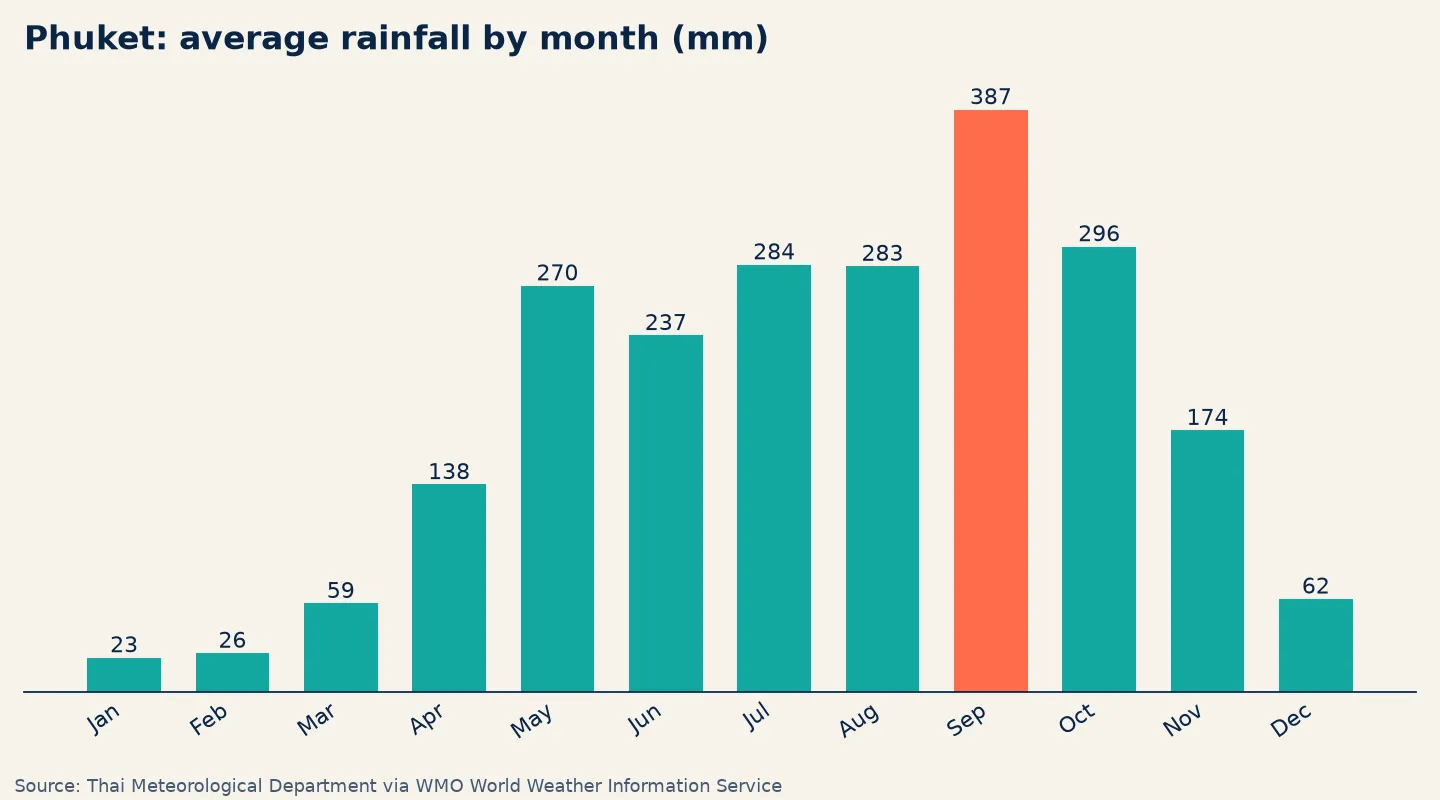
The same pattern applies to Krabi, Khao Lak and the islands off that coast, which share Phuket’s monsoon. If your only dates are in August or September, the Andaman side is the wrong coast. It is not ruled out, but expect rain on most days and fewer boat trips: the Similan Islands national park off this coast closes to visitors for the monsoon, and in 2026 the Tourism Authority of Thailand reported them reopening on 15 October after a five-month closure. Maya Bay, the cove off Phi Phi, reopened on 1 October.
Best time to visit Ko Samui and the Gulf islands
The Gulf works best from February to August. Ko Samui’s driest months are February to April, at 58 to 78 mm. From June to September it gets 113 to 123 mm a month, less than half of Phuket’s rainfall in the same months. That makes the Gulf islands, Ko Samui, Ko Pha-ngan and Ko Tao, the better beach choice for a summer holiday.

Avoid October to December on this coast if beach days are the point of the trip. A December holiday that combines Bangkok with Ko Samui pairs the driest month in the capital with one of the wettest on the island.
So which coast? Between November and April, the Andaman coast is the drier one. Between June and September, the Gulf is. February and March are dry on both, so either works.
Best time to go to Thailand for Bangkok and the north
For sightseeing, aim for November to February. Bangkok gets 9 to 10 mm of rain in December and January, with highs of 31°C to 32°C (88°F to 90°F) and lows of about 21°C (70°F). That is as comfortable as the city gets. March and April are dry but hot, peaking at an average high of 34.9°C (95°F) in April. The season chart on our page of Bangkok hotels shows how demand moves through the year.
Chiang Mai is where the cool season is real. Average lows fall to 14°C (57°F) in January and 15°C (59°F) in December, so pack a layer for the evenings, and the rain all but stops (8 mm in January). April is the opposite, with an average high of 36.1°C (97°F), the hottest of the four places in the table. From May to October Chiang Mai is green and wet, peaking at 225 mm in August.
The dry season also has an air-quality catch. GOV.UK warns that Bangkok and Chiang Mai are affected by seasonal regional smoke haze from farmers burning trees and crops. It does not give months, so if you are heading north late in the dry season, check the current air-quality readings before you book, especially if you have asthma or are travelling with children.
Festivals and holidays that change your trip
Loy Krathong in November
The festival falls on the full moon of the twelfth Thai lunar month, which the Tourism Authority of Thailand gives as 24 November in 2026. Bangkok’s riverside programme runs from 17 to 29 November, with the main sites busiest from 23 to 25 November. In the north, the CAD Khomloi sky-lantern festival in Mae On district, outside Chiang Mai, runs on 24 and 25 November. Phuket marks it at Saphan Hin from 16 to 25 November. The date follows the lunar calendar, so it moves each year.
Christmas and New Year on the Andaman coast
The driest weeks on the west coast are also the most sought after, so this is the period to book early. A free-cancellation rate lets you move if a better date opens up. For timing the flight, read when to book flights; for the room, our tips on finding cheap hotel deals.
Songkran in April
The Thai New Year water festival falls in the hottest month of the year. Expect to get soaked in the main streets of Bangkok and Chiang Mai, and expect busier transport around it.
Before you book: entry rules for this season
The rules changed this autumn, and they are now the same for British and American tourists. GOV.UK says that from 15 September 2026, British visitors entering under the visa exemption can stay for up to 30 days, for tourism only. The Royal Thai Embassy in Washington gives the same 30 days for US citizens from the same date, subject to conditions. Every foreign visitor, whatever their passport, must also complete the Thailand Digital Arrival Card online within the three days before arrival; it is not a visa. GOV.UK adds that your passport needs at least six months’ validity on arrival.
For flights, compare flights from London to Bangkok. If you want the beach in December but would rather avoid a long-haul flight, our list of where is hot in December sets Phuket against nine shorter options.
Frequently asked questions
What is the cheapest time to visit Thailand?
Demand follows the weather. The wet months from May to October are the low season for Bangkok and the Andaman coast, and the Gulf islands are quietest from October to December, their wettest months, so that is where rooms are easiest to find. The season chart on our Bangkok hotel page shows how demand moves month by month.
Is November a good time to visit Thailand?
For Bangkok and Chiang Mai, yes. Rain falls to about 50 mm in both, and Loy Krathong takes place on 24 November in 2026. For beaches, November is mixed: Phuket still averages 174 mm over 16 days, and Ko Samui has its wettest month of the year at 490 mm.
Which side of Thailand is best in July and August?
The Gulf of Thailand side. Ko Samui averages 123 mm of rain in July and 119 mm in August, against 284 mm and 283 mm in Phuket. Ko Pha-ngan and Ko Tao share Ko Samui's pattern. Expect showers on about half the days in either place, but far fewer washed-out beach days on the Gulf.
How hot does Thailand get in April?
April is the hottest month in most of the country. On the Thai Meteorological Department's averages, Bangkok reaches 34.9°C and Chiang Mai 36.1°C, and nights in Bangkok stay above 26°C. Phuket and Ko Samui are slightly cooler by day, at 33.7°C and 32.1°C, because of the sea.
Sources
- WMO World Weather Information Service: Bangkok climatological information (checked 2026-11-13)
- WMO World Weather Information Service: Chiang Mai (checked 2026-11-13)
- WMO World Weather Information Service: Phuket (checked 2026-11-13)
- WMO World Weather Information Service: Ko Samui (checked 2026-11-13)
- Thai Meteorological Department: weather warnings (checked 2026-11-13)
- TAT Newsroom: Loi Krathong 2026 lights up Thailand's rivers and historic cities (5 November 2026) (checked 2026-11-13)
- GOV.UK: Thailand travel advice, entry requirements (checked 2026-11-13)
- GOV.UK: Thailand travel advice, safety and security (checked 2026-11-13)
- GOV.UK: Thailand travel advice, health (air quality) (checked 2026-11-13)
- TAT Newsroom: The Andaman opens its doors again (20 October 2026) (checked 2026-11-13)
- Royal Thai Embassy, Washington DC: visa information (updated 19 October 2026) (checked 2026-11-13)