At a glance
- Le Marais is the safest all-round choice for a first visit; the Latin Quarter is the cheaper central option and has a direct train from Charles de Gaulle.
- Flying into Orly: stay near metro line 14 (Châtelet, Pyramides, Madeleine, Saint-Lazare, Gare de Lyon). Into Charles de Gaulle: near an RER B stop.
- Fixed taxi fares in 2026 make the Left Bank cheaper from Orly (€36) and the Right Bank cheaper from Charles de Gaulle (€56).
- Tourist tax in 2026 runs from €2.60 per adult per night in a 1-star hotel to €8.45 in a 4-star and €15.93 in a palace; under-18s pay nothing.
- Until 11 December 2026 the RER B from Charles de Gaulle stops running at 22:45 on weekdays, so late arrivals need a taxi or the replacement bus.
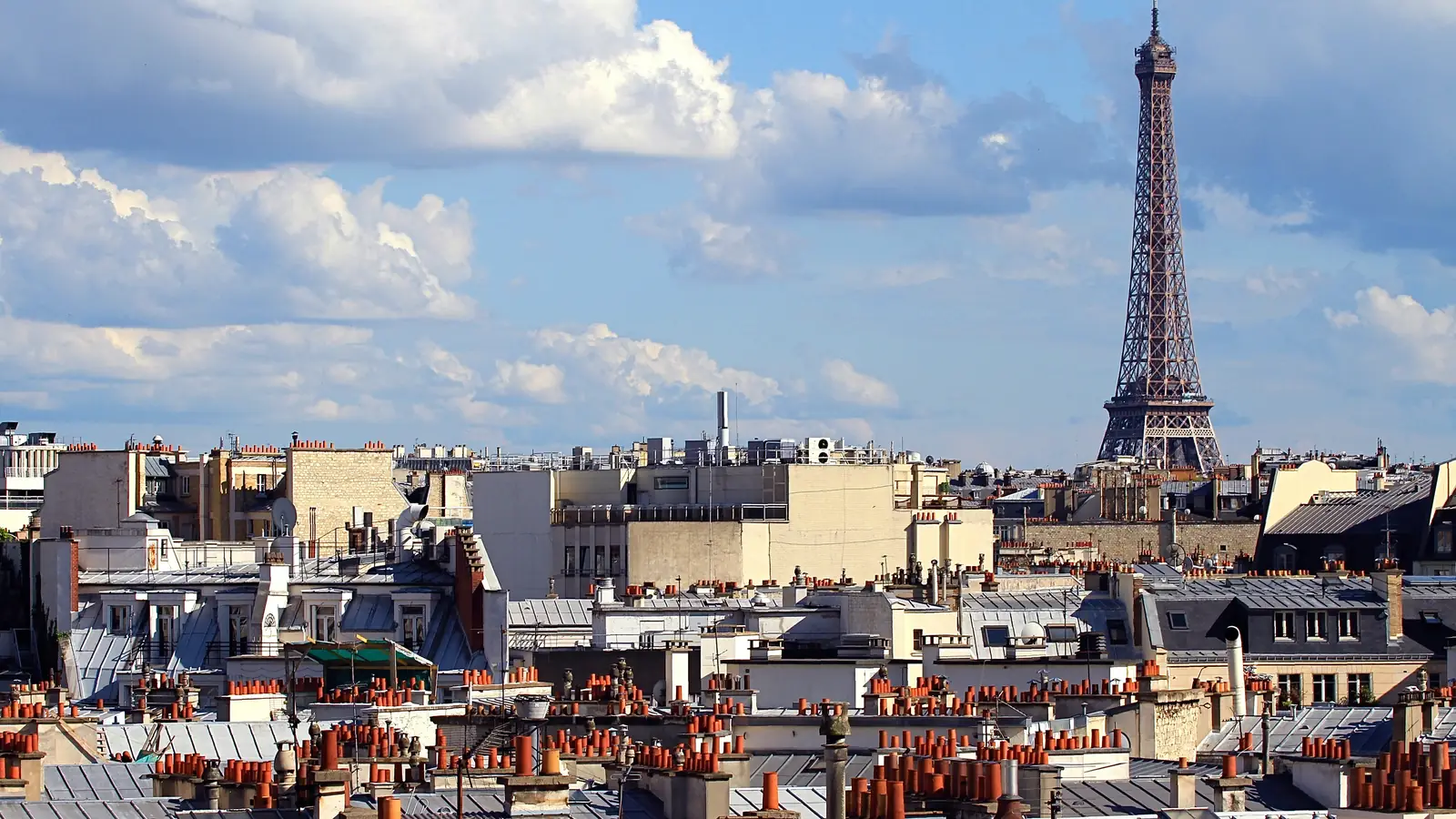
Where to stay in Paris comes down to three central choices for most visitors: Le Marais if you want to walk nearly everywhere and eat well, Saint-Germain-des-Prés for the classic Left Bank, and the Latin Quarter when the budget is tighter. Montmartre, the Louvre and Opéra blocks, the 7th around the Eiffel Tower and the two canal-side districts are for more specific trips. This guide compares all eight, then covers two things that should shape the decision: which airport train reaches which neighbourhood, and how much tourist tax your hotel’s star rating adds.
Which area of Paris is best for a first visit?
Le Marais, for most people. It is central, it sits on metro line 1, and the Paris tourist office’s own neighbourhood guide grades it a notch cheaper than the Louvre or Saint-Germain. If you land at Charles de Gaulle and want one train to the door, choose the Latin Quarter instead. You can compare hotels in Paris across all eight in one search.
Here are all eight at once. The price bands used throughout this guide are the ones the Paris tourist office gives each arrondissement, from one euro sign to three, and the last column shows the simpler of the two airport routes.
| Area | Best for | Trade-off | Metro lines | Easiest airport link |
|---|---|---|---|---|
| Le Marais (3rd, 4th) | First visits, food, evenings out | Small rooms in old buildings | 1, 11 | Orly: line 14 to Châtelet |
| Saint-Germain-des-Prés (6th) | Couples, cafés, galleries | Top price band | 4, 10 | Charles de Gaulle: RER B to Saint-Michel Notre-Dame |
| Latin Quarter (5th) | Families, tighter budgets | Crowded lanes near Saint-Michel | 10, RER B | Charles de Gaulle: RER B direct |
| Louvre and Opéra (1st, 9th) | Short stays, shopping | Offices and shops, little local life | 1, 3, 7, 8, 14 | Orly: line 14 direct to Pyramides |
| Montmartre (18th) | Atmosphere, a wide spread of prices | Slopes, stairs, a metro ride to the river | 2, 12 | Orly: line 14 to Saint-Lazare, then line 12 |
| Eiffel Tower and Invalides (7th) | Families who want quiet | Weakest transport of the eight | 6, 8 | Orly: taxi at the Left Bank fare |
| Canal Saint-Martin (10th) | Eurostar arrivals, lower prices | Scruffier beside the stations | 5 | Charles de Gaulle: RER B to Gare du Nord |
| Bastille and Oberkampf (11th) | Nightlife, lower prices | Noise late at night | 1, 5, 8, 9 | Orly: line 14 to Gare de Lyon, then line 1 |
The best areas to stay in Paris, one by one
Le Marais (3rd and 4th arrondissements)
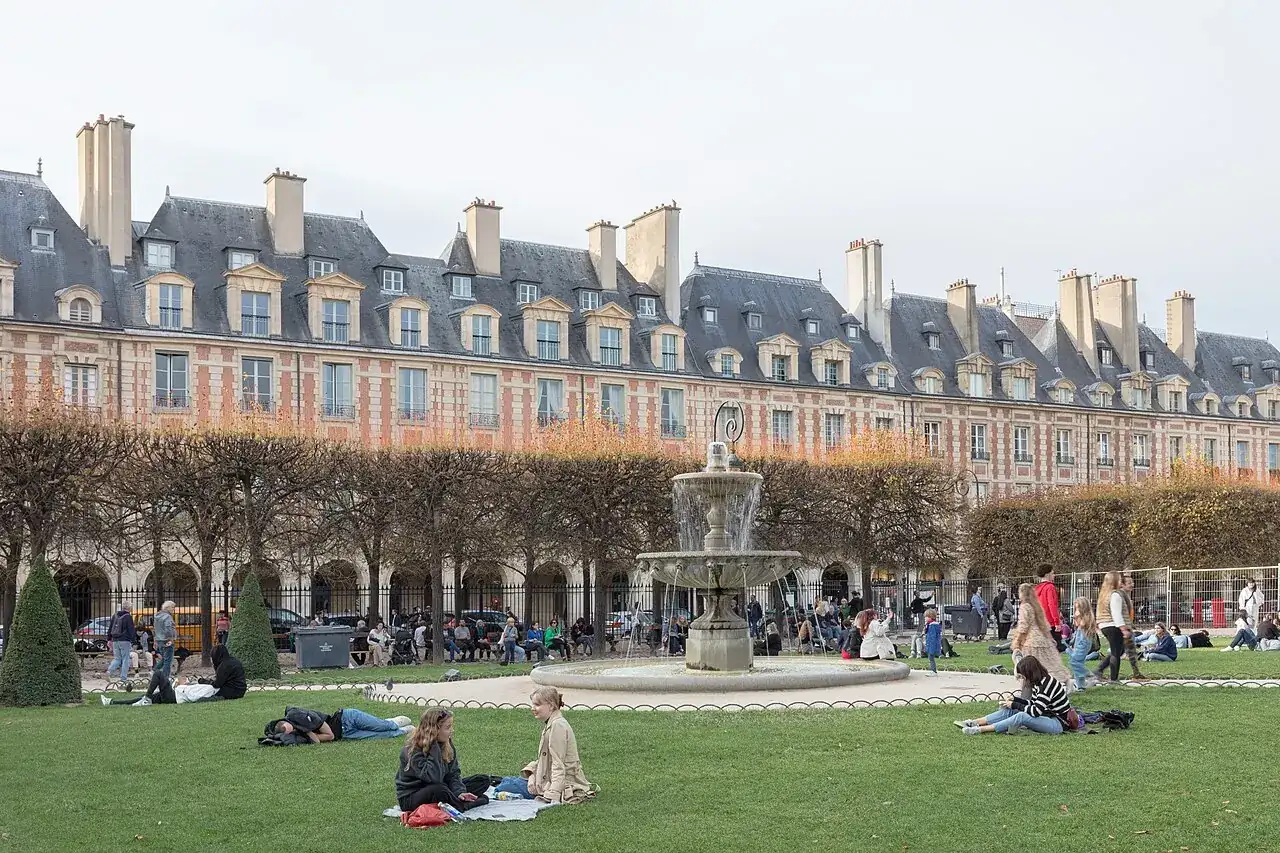
The Marais is the web of old streets between the Hôtel de Ville and Place des Vosges, and it works for more kinds of trip than anywhere else in the city. It is historic and fashionable at once, and it is the centre of the city’s LGBT+ nightlife. Notre-Dame and the Louvre are both a walk away, and the Latin Quarter is just across the river by way of the two islands, so a first-time visitor can cover most of a three-day list on foot.
Saint-Paul is on line 1, which also stops at the Louvre; Hôtel de Ville adds line 11. Line 14 from Orly and the RER B from Charles de Gaulle both reach Châtelet, one stop from Hôtel de Ville.
The downside is the buildings. They are old and narrow, so hotels tend to be small, rooms compact and lifts tiny or absent. Check the room size and whether there is a lift before you book.
Saint-Germain-des-Prés (6th)
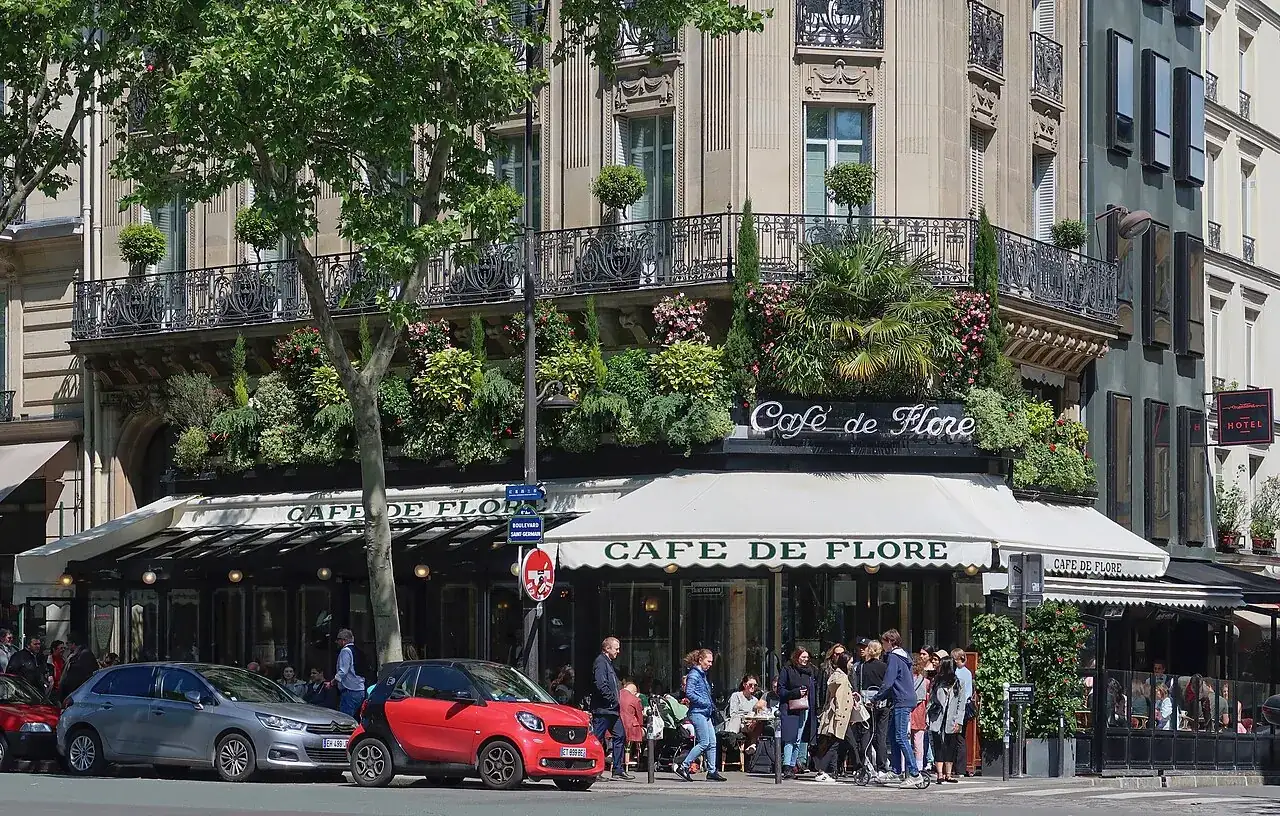
This is the Left Bank of café terraces, bookshops and galleries, with the Luxembourg Gardens on its southern side. It sits in the top price band, and that is the trade-off: you pay for the address.
Line 4 stops at Saint-Germain-des-Prés, and Odéon has lines 4 and 10. The RER B from Charles de Gaulle calls at Saint-Michel Notre-Dame on the area’s eastern edge, one stop from Odéon. From Orly a taxi costs the lower Left Bank fare (see the airport section below).
Latin Quarter (5th)
One train from Charles de Gaulle and no change: the RER B stops at Saint-Michel Notre-Dame and at Luxembourg, and only one other area in this guide can match that. Add prices a band below Saint-Germain next door and you have the best answer for anyone who wants to be central on a tighter budget. This is the university district, so affordable restaurants are easy to find, which is one reason families favour it.
Line 10 serves Cluny-La Sorbonne and Cardinal Lemoine, and Saint-Germain begins where the 5th ends, so its cafés and galleries are a walk away. The lanes closest to Saint-Michel are packed with visitors until late; for a quieter night, look further south towards the Panthéon and the Luxembourg Gardens.
Louvre and Opéra (1st and 9th)
On a two-night trip, time matters more than atmosphere, and the 1st is as central as Paris gets. It is in the top price band. The 9th, around the Palais Garnier and the big department stores, costs slightly less.
The transport is the strongest of any area: Palais Royal-Musée du Louvre has lines 1 and 7, Opéra has 3, 7 and 8, and Pyramides is on line 14, which makes this the simplest base for Orly. The cost is atmosphere: these streets of offices, shops and museums empty out in the evening.
Montmartre (18th)
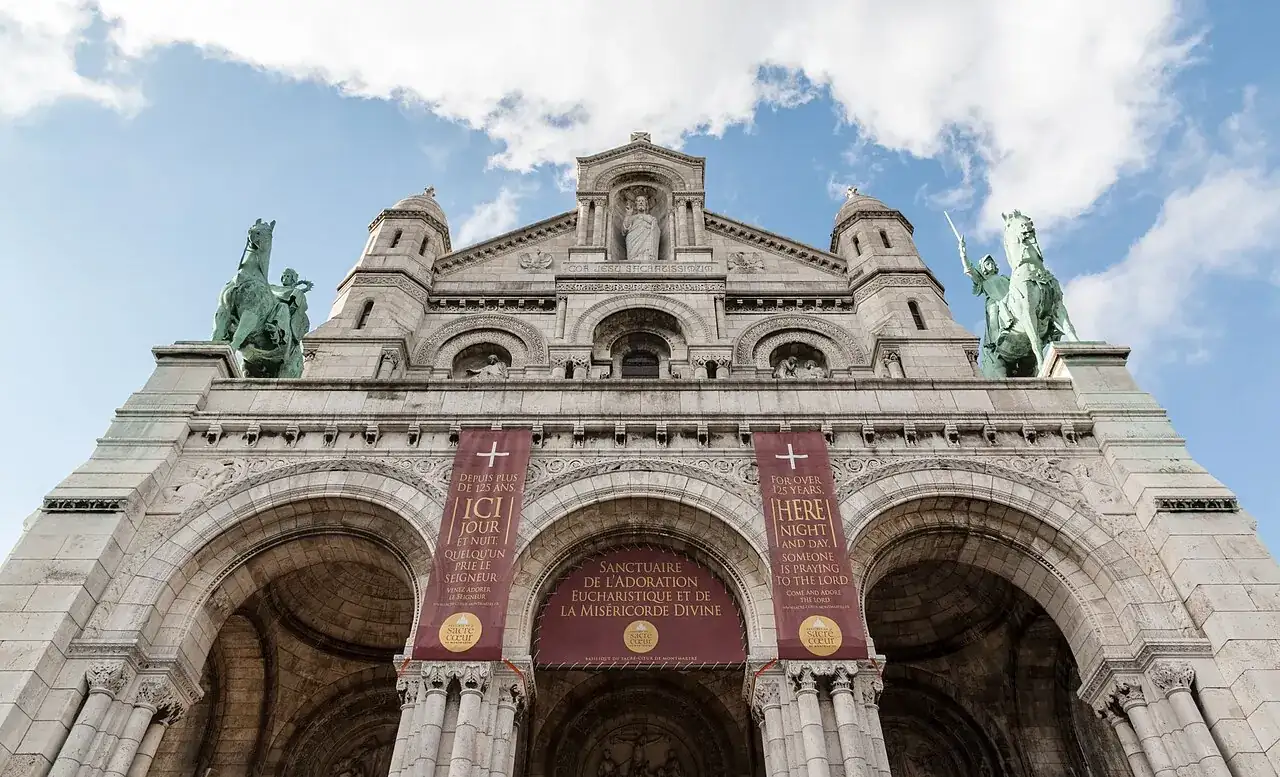
Montmartre is the hilltop village around the Sacré-Cœur, and its hotels span all three price bands, the widest spread of any area here.
Which part of the hill you pick matters. Abbesses, halfway up, is the village side, with small squares and quieter streets. Pigalle, on the boulevard at the bottom, is the nightlife strip, busier and rougher after dark. The streets are steep and many end in staircases, so with a pushchair, heavy bags or limited mobility, choose a hotel at the foot of the hill.
You are a metro ride from everything else, but a direct one. Line 12 runs from Abbesses and Pigalle to Madeleine without a change, and line 2 from Anvers or Pigalle goes straight to the Arc de Triomphe at Charles de Gaulle-Étoile.
Eiffel Tower and Invalides (7th)
Is it worth staying near the Eiffel Tower? Only if a view of it and quiet evenings are the point of the trip. The 7th is calm, formal and residential, which suits families, but it is in the top price band and its transport is the weakest of the eight: line 8 at École Militaire and line 6 at Bir-Hakeim, with no direct airport train. Otherwise you are paying a premium to be a metro ride from where you will spend your days.
Canal Saint-Martin (10th)
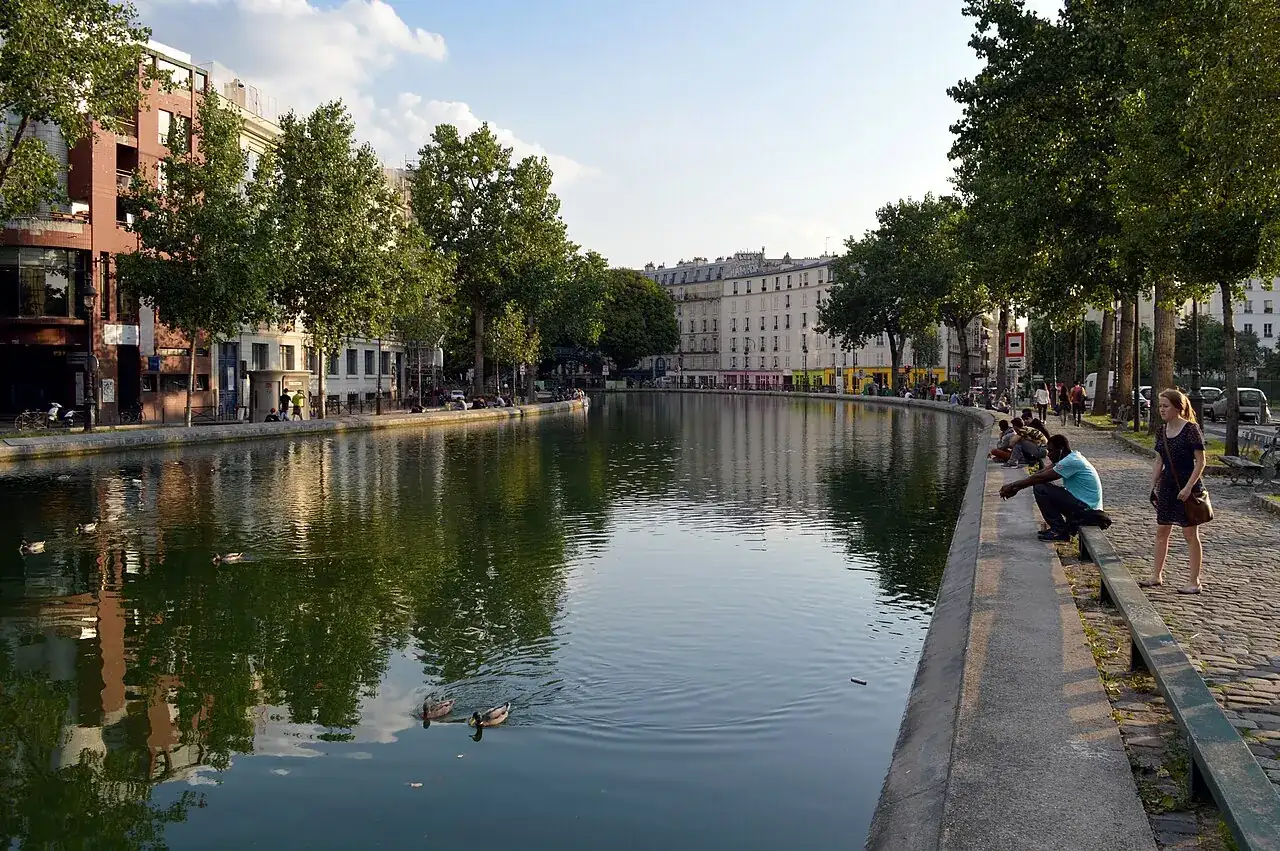
The 10th is two places in one. Along the canal it is footbridges, plane trees and independent cafés; around Gare du Nord and Gare de l’Est it is a busy station district. Prices sit in the lowest two bands, and nowhere is handier for the Eurostar or for Charles de Gaulle, because the RER B stops at Gare du Nord. Line 5 links the station with Jacques Bonsergent, near the canal, and carries on to République and Bastille, while line 4 from Gare du Nord runs direct to Châtelet, Saint-Michel and Saint-Germain-des-Prés.
Bastille and Oberkampf (11th)
Come here for the bars. Bastille (lines 1, 5 and 8) and Oberkampf (lines 5 and 9) are where Parisians go out, at prices like the 10th’s, and line 1 from Bastille reaches the Marais and the Louvre without a change. Ask for a room facing the courtyard, because the bars stay open late.
Which parts of Paris should you think twice about?
Neither the UK Foreign Office nor the US Embassy in Paris names a neighbourhood to avoid, so this is a question of fit, not danger. Three choices tend to disappoint:
- The blocks immediately around Gare du Nord and Gare de l’Est. Fine for one night before an early train, wearing for a week.
- The Champs-Élysées (8th). Top price band, and most of what you came to see is somewhere else.
- Outside the ring road. Rates drop, but each day starts and ends with a longer ride. Check which metro line the hotel is on, and how far the walk is, before the price persuades you.
Petty theft is the real risk. The Foreign Office warns that thieves and pickpockets work the metro, the RER and the mainline stations, and it singles out the RER B, the airport line. Keep bags closed and in front of you on that journey.
Where to stay in Paris for your airport
Match the hotel to the airport line and you can skip a change with luggage.
Charles de Gaulle. The RER B stops in the centre at Gare du Nord, Châtelet-Les Halles, Saint-Michel Notre-Dame and Luxembourg. Paris Aéroport puts the journey at around 35 minutes. That favours the Latin Quarter, Canal Saint-Martin and the eastern side of Saint-Germain.
Orly. Metro line 14 runs to Gare de Lyon, Châtelet, Pyramides, Madeleine and Saint-Lazare, reaching Châtelet in 25 minutes according to Île-de-France Mobilités, which also describes the line as fully accessible. With a pushchair or heavy cases it is the easier of the two.
Either train needs the airport ticket, €14 as of 2026. It is not valid on buses or trams, it cannot be loaded on the same card as other tickets, and the €12.30 Navigo day pass, although it is valid in every zone, does not cover the airports.
Taxis from the official ranks charge fixed fares set by government order, and in 2026 they split the city by riverbank:
- Charles de Gaulle: €56 to the Right Bank, €65 to the Left Bank
- Orly: €45 to the Right Bank, €36 to the Left Bank
Saint-Germain, the Latin Quarter and the 7th are on the Left Bank; the other five areas are on the Right. So a Left Bank hotel is the cheaper taxi from Orly and the dearer one from Charles de Gaulle.
One dated warning. Until 11 December 2026, engineering work stops the RER B between Charles de Gaulle and Châtelet-Les Halles from 22:45 on weekdays and some weekends, with replacement buses, and the airport end closes at the same hour again on 14 to 18 December. If your flight lands after about 22:00 on those dates, budget for the taxi. From 28 March 2027 the CDG Express is due to run from the airport to Gare de l’Est in 20 minutes, which will make the 10th the quickest base of all.
How much is the Paris tourist tax, by star rating?
The tax is a fixed sum per adult per night, set by the hotel’s official category, and it is collected during the stay, not when you book. Under-18s are exempt. These are the City of Paris rates for 2026, including the regional additions; the city says the 2027 rates will be the same.
| Category | Per adult, per night | Two adults, three nights |
|---|---|---|
| Palace | €15.93 | €95.58 |
| 5-star | €11.70 | €70.20 |
| 4-star | €8.45 | €50.70 |
| 3-star | €5.53 | €33.18 |
| 2-star | €3.25 | €19.50 |
| 1-star, hostel or B&B | €2.60 | €15.60 |
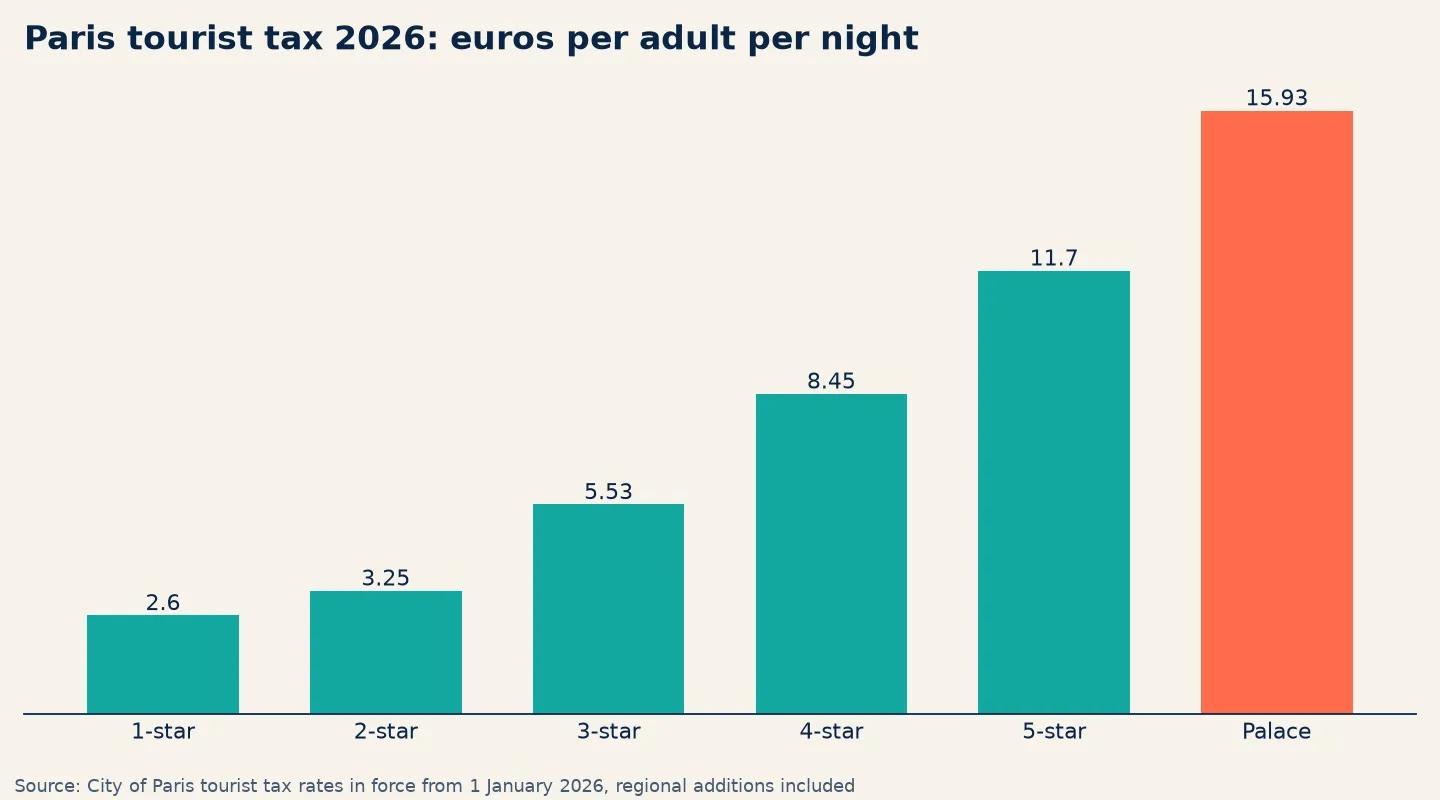
The step from a 3-star to a 4-star costs a couple €17.52 over a long weekend, before any difference in the room rate.
Unrated apartments work differently. The tax is 5% of the nightly price per person, before tax, plus the same regional additions, up to a ceiling of €15.93. The price is divided by everyone staying, children included, although only adults pay. Take a flat at an example price of €200 a night for two adults and two children: €50 a head, 5% is €2.50, and the additions bring it to about €8.13 per adult. That is €16.25 a night for the family, against €11.06 for the same two adults in a 3-star hotel.
Booking tips before you choose
Compare totals with the tax added, since it is often missing from the first price you see. A rate with free cancellation lets you hold a room in your first-choice area and keep checking, and our guide to finding cheap hotel deals lists the other extras to look for. The season chart on the Paris hotels page shows which months are quietest; for a cold-weather trip, see how Paris compares in our winter city breaks guide. If flights are still open, read when to book flights before you fix the dates.
You do not need a car in any of these areas, and central Paris discourages one: the 1st to 4th arrondissements have been a limited traffic zone since November 2024, and a low-emission zone restricts older vehicles on weekdays. If Paris is the start of a longer drive, collect the car on the day you leave and run through our car rental checklist first.
Frequently asked questions
Is it better to stay on the Left Bank or the Right Bank?
For a first visit it matters less than the specific area, because the Marais on the Right Bank and Saint-Germain on the Left are a short walk apart across the river. The Right Bank has more metro lines and the wider choice of hotels; the Left Bank is quieter in the evening and cheaper by taxi from Orly.
Which area of Paris is best if I arrive by Eurostar?
Eurostar trains arrive at Gare du Nord in the 10th arrondissement. For a short trip, the canal side of the 10th keeps you within a walk or one metro stop of the station. Otherwise line 4 from Gare du Nord runs south to Saint-Michel, Odéon and Saint-Germain-des-Prés, and line 5 runs to République, Oberkampf and Bastille.
Is the tourist tax included in the hotel price I see online?
Often not. The City of Paris collects the tax at the time of the stay, so many hotels add it to the bill at check-in or check-out. Look for a line such as city tax or taxe de séjour in the price breakdown, and if it is missing, add the nightly amount for the hotel's star rating yourself.
Can I use a day pass to get from the airport to my hotel?
No. The Navigo day pass (€12.30 in 2026) is valid in every zone but not at the airports. You need the separate airport ticket for the RER B from Charles de Gaulle or metro line 14 from Orly, loaded on its own Navigo Easy card or on a phone. The Paris Visite pass does include the airports.
Sources
- Paris je t'aime (tourist office): Where to stay in Paris, by neighbourhood and arrondissement (checked 2026-11-11)
- City of Paris: tourist tax rates in force from 1 January 2026 (PDF) (checked 2026-11-11)
- City of Paris: tourist tax portal (exemptions, collection, 2027 rates) (checked 2026-11-11)
- Service-Public.fr: Paris tourist tax 2026 (checked 2026-11-11)
- Île-de-France Mobilités: Paris Region – Airports ticket (checked 2026-11-11)
- Île-de-France Mobilités: ticket prices from 1 January 2026 (checked 2026-11-11)
- Île-de-France Mobilités: metro line 14 to Orly and the end of Orlybus (checked 2026-11-11)
- Île-de-France Mobilités open data: stops by line (checked 2026-11-11)
- Paris Aéroport: public transport between Paris and Charles de Gaulle (checked 2026-11-11)
- Service-Public.fr (Entreprendre): taxi fares for 2026 (checked 2026-11-11)
- Bonjour RATP: RER B closure dates and times (checked 2026-11-11)
- CDG Express: opening date and journey time (checked 2026-11-11)
- City of Paris: limited traffic zone in the city centre (checked 2026-11-11)
- City of Paris: low-emission zone (checked 2026-11-11)
- GOV.UK: France travel advice, safety and security (checked 2026-11-11)
- US Embassy in France: safety advice for Paris (checked 2026-11-11)


