
At a glance
- The levy is 5% of the accommodation cost before VAT, charged on the first five consecutive nights of a booking.
- It applies to stays from 24 July 2026 in all paid accommodation in the City of Edinburgh Council area.
- At a VAT-registered hotel it works out at 5% of the room price you see, because VAT is charged on the levy too.
- The five-night cap is per booking: splitting a week between two places means paying on all seven nights.
- People on certain disability benefits pay first and claim it back from the council after the stay.
The Edinburgh tourist tax is a 5% charge on the cost of your accommodation, applied to the first five nights of a stay. Its official name is the Edinburgh Visitor Levy. It has applied to overnight stays since 24 July 2026 and covers every kind of paid accommodation inside the city council boundary, from hotels to campsite pitches. Below is what it adds to a bill, how the five-night cap really works, who can claim the money back and where else in the UK a similar charge is on the way.
How much is the Edinburgh tourist tax?
The City of Edinburgh Council sets the levy at 5% of the accommodation-only cost, before VAT. Parking, meals, drinks and transport are left out of the sum. A charge you cannot opt out of, such as standard cleaning built into the price of a flat, counts as accommodation.
There is one detail most summaries miss. Where the accommodation provider is VAT-registered, VAT is charged on the levy as well, according to the VisitScotland guidance the council cites. You do not need to work that out yourself. At a VAT-registered hotel the levy and its VAT together add 5% to the room price you see when you book: £6 on a £120 night, for example.
| Example room price per night (including VAT) | Levy | VAT on the levy | Added per night | Most you pay (five nights) |
|---|---|---|---|---|
| £120 | £5.00 | £1.00 | £6.00 | £30.00 |
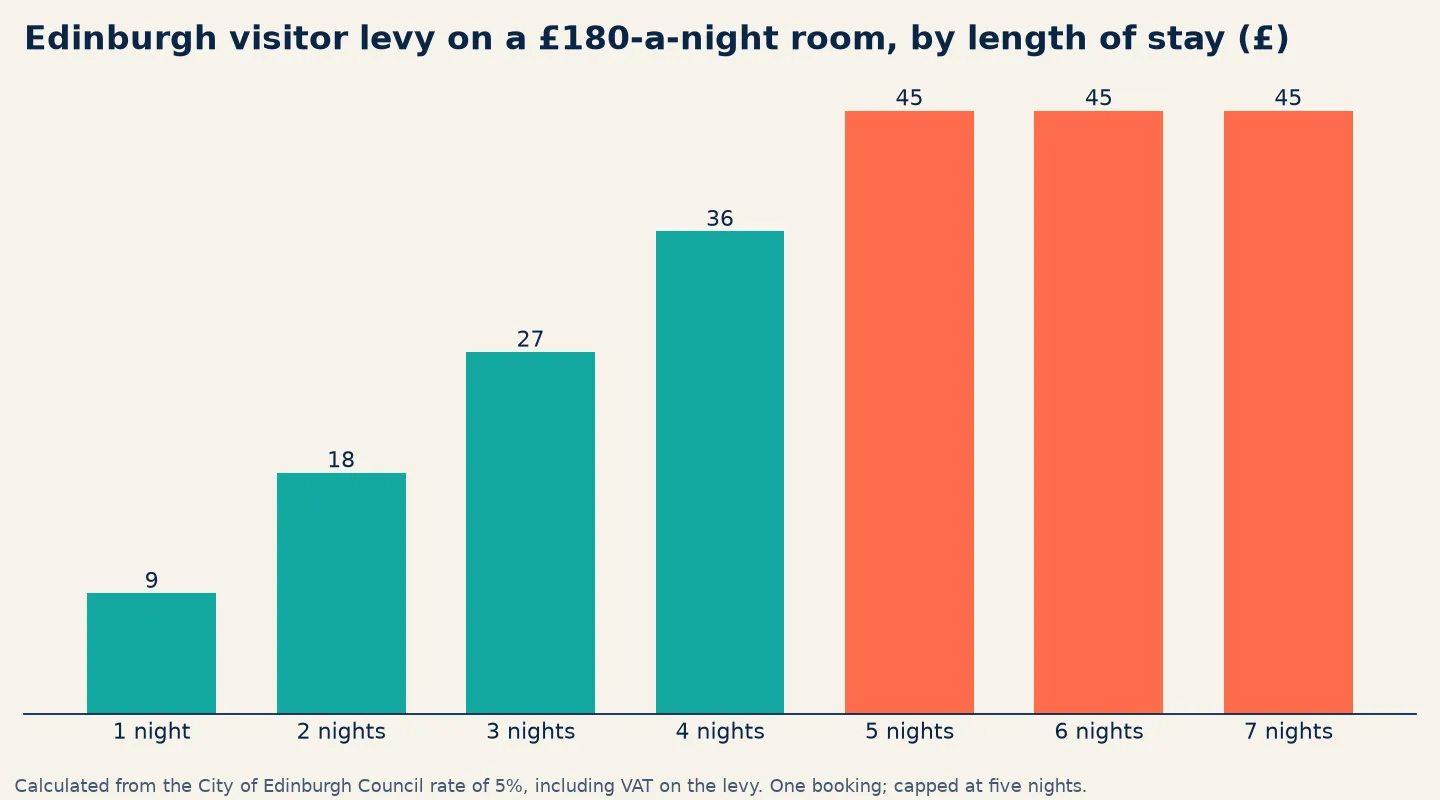
| £180 | £7.50 | £1.50 | £9.00 | £45.00 |
| £300 | £12.50 | £2.50 | £15.00 | £75.00 |
The room prices are examples to show the sums, with VAT at 20%. A small guest house or short-term let below the VAT threshold still has to charge the levy, but with no VAT on top of it.
Because the charge follows the price of the room, it is neither a per-person fee nor a flat nightly one. Two people sharing pay the same as one person in the same room, and a night in August, when festival demand pushes rates up, carries a bigger levy than the same room in November.
How does the five-night cap work?
The levy is payable for a maximum of five consecutive nights. The cap belongs to the booking, not to you, so splitting a long stay costs more. Stay seven nights on one booking and you pay on five of them. Split that week between two properties and each booking starts its own count, so you pay on all seven nights. At £180 a night that is £63 instead of £45.
The same applies if you leave and come back. The council’s guidance for accommodation providers gives the example of a guest who stays four nights, checks out, then returns for two more: all six nights are charged. On a longer trip, one booking at one property is the cheaper way to do it.
Which accommodation does the Edinburgh visitor levy cover, and from when?
The scheme covers the whole City of Edinburgh Council area and applies to:
- hotels, guest houses and bed and breakfasts
- hostels
- self-catering accommodation, including short-term lets
- paid pitches on caravan sites and campsites, including tent and campervan pitches
It applies to stays from 24 July 2026 where the booking was made on or after 1 October 2025. Booking before the levy started does not get you out of it; only bookings made and at least partly paid before 1 October 2025 fall outside. If you reserved a 2026 or 2027 stay any time after that date and the confirmation shows no levy, ask the property whether it is included or will be added at check-in. Where you live makes no difference either. The council states that UK and Scottish residents are liable in the same way as visitors from abroad.
Who is exempt from the tourist tax, and who can claim a refund?
Two groups are treated differently. People with no only or usual place of residence are not liable at all: that covers people who are homeless or at risk of homelessness, those leaving unsafe housing or domestic abuse, and asylum seekers and refugees.
People receiving certain disability benefits, including Disability Living Allowance, Personal Independence Payment, Attendance Allowance and Adult Disability Payment, can get the levy back, but not at the reception desk. They pay it with the bill, then claim from the council through its online form once the stay has ended. The claim needs the benefit award letter, an invoice in the claimant’s name and proof of payment, so ask for a named invoice before you check out and keep the receipt. The council says it will pay within five working days of receiving the documents. The hotel plays no part in the refund and will still charge the levy, so budget for the full bill and treat the refund as money that arrives after you are home.
When do you pay the levy: at booking or at the hotel?
The accommodation provider is legally responsible for the levy and passes it to the council. How it reaches your bill is the provider’s choice: it can be charged at reservation, at check-in or at check-out, and a provider may also absorb it. No regulation yet requires a separate line on the invoice, although the total price including the levy must be clear when you book.
That matters when you compare prices. One property’s headline rate may already contain the levy while another adds it at the desk, so check the final total rather than the first figure. The same habit catches most of the other extras listed in our guide to finding cheap hotel deals. If you cancel or do not turn up, the levy should come back to you, because it only becomes payable when you take up the room. A rate with free cancellation therefore protects the levy as well as the room cost.
Where else in the UK is a visitor levy coming?
Glasgow is next, in January 2027, and three more Scottish councils and Cardiff follow by July. The table lists every charge we could confirm from an official source in November 2026, in date order after Edinburgh.
| Place | Charge | Applies from |
|---|---|---|
| Edinburgh | 5%, first five nights | 24 July 2026 |
| Glasgow | 5%, whole stay | 25 January 2027 |
| Aberdeen | 7%, whole stay | 1 April 2027 |
| Cardiff | £1.30 per person per night; 75p in hostels and on tent pitches | 1 April 2027 |
| Stirling | 3% | 14 June 2027 |
| West Dunbartonshire | 5% | 1 July 2027 |
| Manchester | £1 per room per night, plus VAT where it applies | April 2023 |
| Liverpool | £2 per room per night | Already in place |
Manchester and Liverpool are not council taxes: hotels there collect the charge through an accommodation business improvement district. In England more widely, the government has said it is giving mayoral strategic authorities the power to create overnight visitor levies, with no start date published yet.
What does the money pay for?
The council expects the levy to raise £45 to £50 million a year by 2028/29. After fixed sums for housing and tourism pressures, the rest is divided between city operations and infrastructure (55%), culture, heritage and events (35%) and destination and visitor management (10%).
When you compare hotels in Edinburgh, add 5% to any rate that does not already include the levy. It applies to accommodation only, so car rental at Edinburgh Airport is unaffected.
Frequently asked questions
Is the Edinburgh tourist tax charged per person or per room?
Neither. It is 5% of what the accommodation costs before VAT, so it follows the price of the booking. Two people sharing a room pay the same levy as one person in that room, and a dearer room or a pricier week means a higher charge.
Do people who live in Scotland pay the Edinburgh visitor levy?
Yes. The council states that all paid overnight stays are liable, including those by UK and Scottish residents. The only people outside the levy are those with no usual home, such as people who are homeless or seeking asylum, while people on certain disability benefits can claim a refund.
Does the levy apply if I booked before it started?
Usually, yes. It covers stays from 24 July 2026 where the booking was made on or after 1 October 2025. Only bookings made and at least partly paid before 1 October 2025 are outside it, so an early booking made in 2026 is still charged.
Sources
- City of Edinburgh Council: About the Edinburgh Visitor Levy (checked 2026-11-10)
- City of Edinburgh Council: Visitor Levy Scheme, area, start date and duration (checked 2026-11-10)
- City of Edinburgh Council: Information for accommodation providers (version 2.1, September 2026) (checked 2026-11-10)
- City of Edinburgh Council: Information for visitors, exemptions (checked 2026-11-10)
- City of Edinburgh Council: Investing the levy's funds (checked 2026-11-10)
- VisitScotland: Visitor levy frequently asked questions (checked 2026-11-10)
- Welsh Government: A visitor levy for Wales (checked 2026-11-10)
- GOV.UK: Overnight visitor levy in England (checked 2026-11-10)
- Manchester Accommodation BID (checked 2026-11-10)
- Liverpool BID Company: Accommodation BID charge (checked 2026-11-10)
